What to say
Why "it won't hurt" backfires, and what to say instead.
By M.F. Chang · July 2026 · 5 min read
Every parent has said it: "Don't worry, it won't hurt." We mean it kindly. We want the fear to shrink. But when the shot does pinch, or the first day is scary, a child learns something we never intended: that the person they trust most doesn't always tell them the truth about how things feel.
Why false reassurance backfires
Small children are excellent fact-checkers of their own bodies. When your words and their experience don't match, they don't conclude "I misheard." They conclude "I can't fully trust what the grown-ups say." The next time you offer comfort, it carries a little less weight. Honesty, even about hard things, is what keeps your reassurance believable when it really counts.
Give small-and-true words instead
The goal isn't to scare a child with the whole truth. It's to give them a true thing that's small enough to hold. Honest words tend to do three jobs at once: they tell the truth, they stay short, and they hand the child something to do.
- "It's quick." True, and it gives the discomfort an ending they can wait out.
- "I'm right here." Not a promise it won't hurt. A promise they won't be alone.
- "You can squeeze my hand." Turns a helpless moment into one where they have a job.
Name the feeling, don't deny it
"There's nothing to be scared of" tells a frightened child their feeling is wrong. "You're feeling scared, and that makes sense" tells them the feeling is allowed, and that you're still calm anyway. Naming an emotion out loud actually helps a child settle: it hands the big, wordless thing a label, and a labeled feeling is far easier to carry than a nameless one.
Scripts you can borrow
Keep them short. You're not giving a speech. You're handing over a true, steady sentence.
Drop-off
- "You're sad I'm leaving. That's okay. I always come back, after songs and snack."
- "It's hard to say goodbye. You can hug Teacher when you need to feel brave."
Shots and the doctor
- "This is going to pinch for a second, then it's done. I'm right here."
- "You can squeeze my hand as hard as you want. Ready? We'll count to three."
The dark
- "The dark can feel big. Your room is the same room it is in the daytime. I checked."
- "I'm just down the hall. If you need me, I'll come. You're safe."
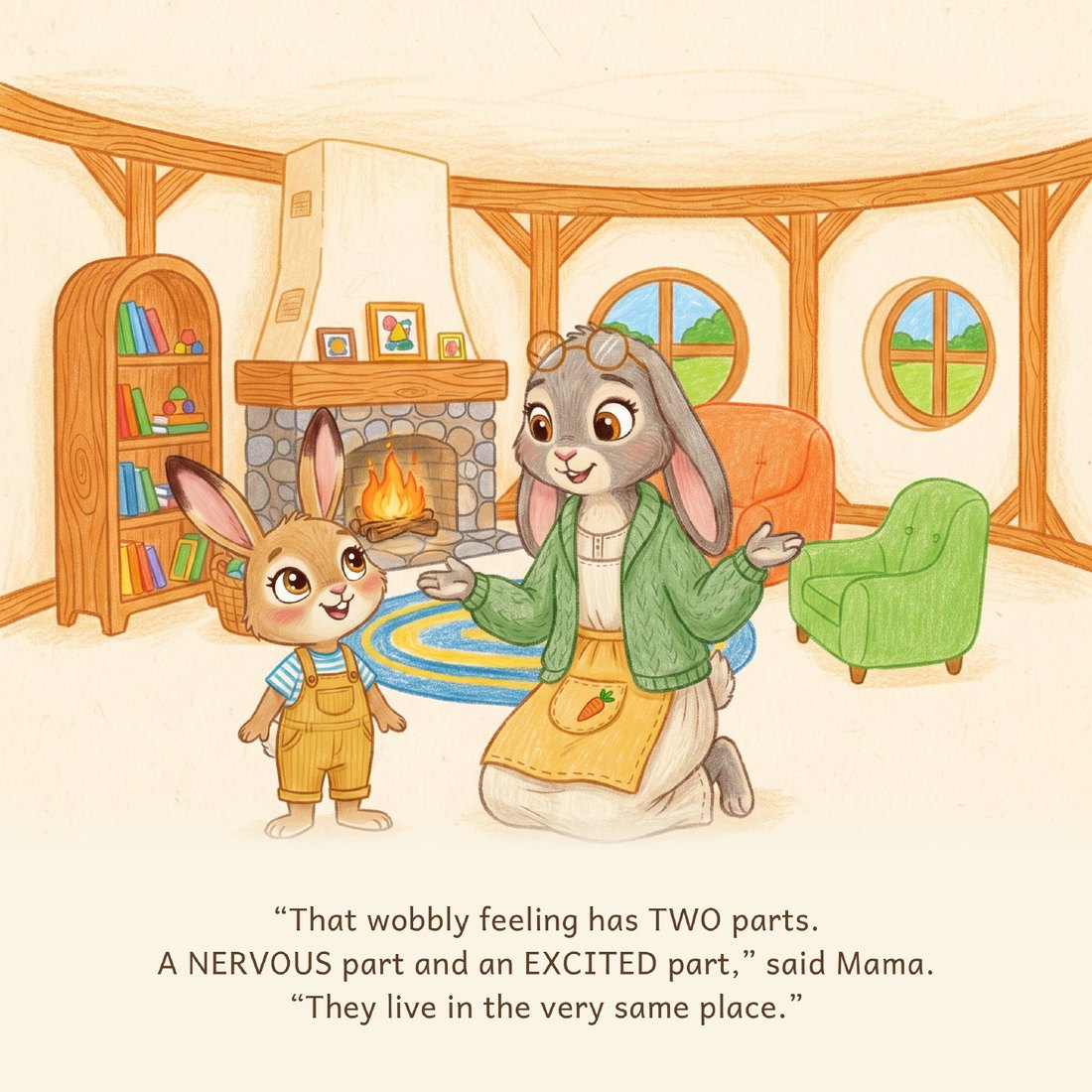
Mama Mimi's honest words
Throughout Pip's First Day of School, Mama Mimi never tells Pip that a hard thing won't be hard. Instead she names it and stays close: "It's a big feeling, and I'm right here." That's the whole approach: don't argue with the feeling, don't oversell the outcome. Tell the small truth, stay near, and give your child one thing to do with their hands. Honesty is the kindest reassurance there is, because it's the one they'll still believe tomorrow.