Drop-off
Three first-day-of-school books, and which one fits your child.
By M.C. Brightwood · September 2026 · 5 min read
Ask ten parents for a first-day-of-school book and you will hear the same two titles: The Kissing Hand and Llama Llama Misses Mama. Both have earned it. We wrote a third, Pip's First Day of School, and we are not going to pretend the other two do not exist. The honest answer is that the three books do different jobs, because a hard drop-off has three different moments: the days before, the goodbye at the door, and the long stretch after you have gone. Pick the book for the moment your child struggles with.
The Kissing Hand (Audrey Penn, 1993)
What it does. Chester, a young raccoon, does not want to leave his mother for school. Mrs. Raccoon kisses the center of his palm and tells him that whenever he presses that hand to his cheek, he will feel her love with him even while they are apart. That is the whole device, and it is a lovely one: a piece of the parent that travels in the child's pocket.
Best for: a child who is fine at the door but needs something to hold onto once you are gone. The kissing hand is a comfort object without the object, so it survives a "no toys from home" rule. It has been in print since 1993, so your child's teacher may well know it.
Where it stops. The book gives your child something to carry. It does not rehearse the goodbye itself, and it does not name the mixed feeling that makes a three-year-old's stomach flip. If the tears come at the door rather than after it, this one is only half the answer.
Llama Llama Misses Mama (Anna Dewdney, 2009)
What it does. It is Llama Llama's first day of preschool. He arrives with Mama Llama and is excited, right up until she leaves for work. Then he is upset and worried she will not come back. His teacher and new classmates help him through the day, and Mama Llama returns at pickup. Dewdney's rhymes make it an easy read-aloud even on a rushed morning.
Best for: a child who falls apart mid-morning, after the goodbye is already over. The book shows the missing as normal, shows the day getting better, and ends with the return. That is the exact arc a sad-at-snack-time child needs to see.
Where it stops. The goodbye happens fast and the comfort comes from the classroom. There is no plan a parent can copy for the door, and nothing to practice at home before the day.
Pip's First Day of School (M.C. Brightwood, 2026)
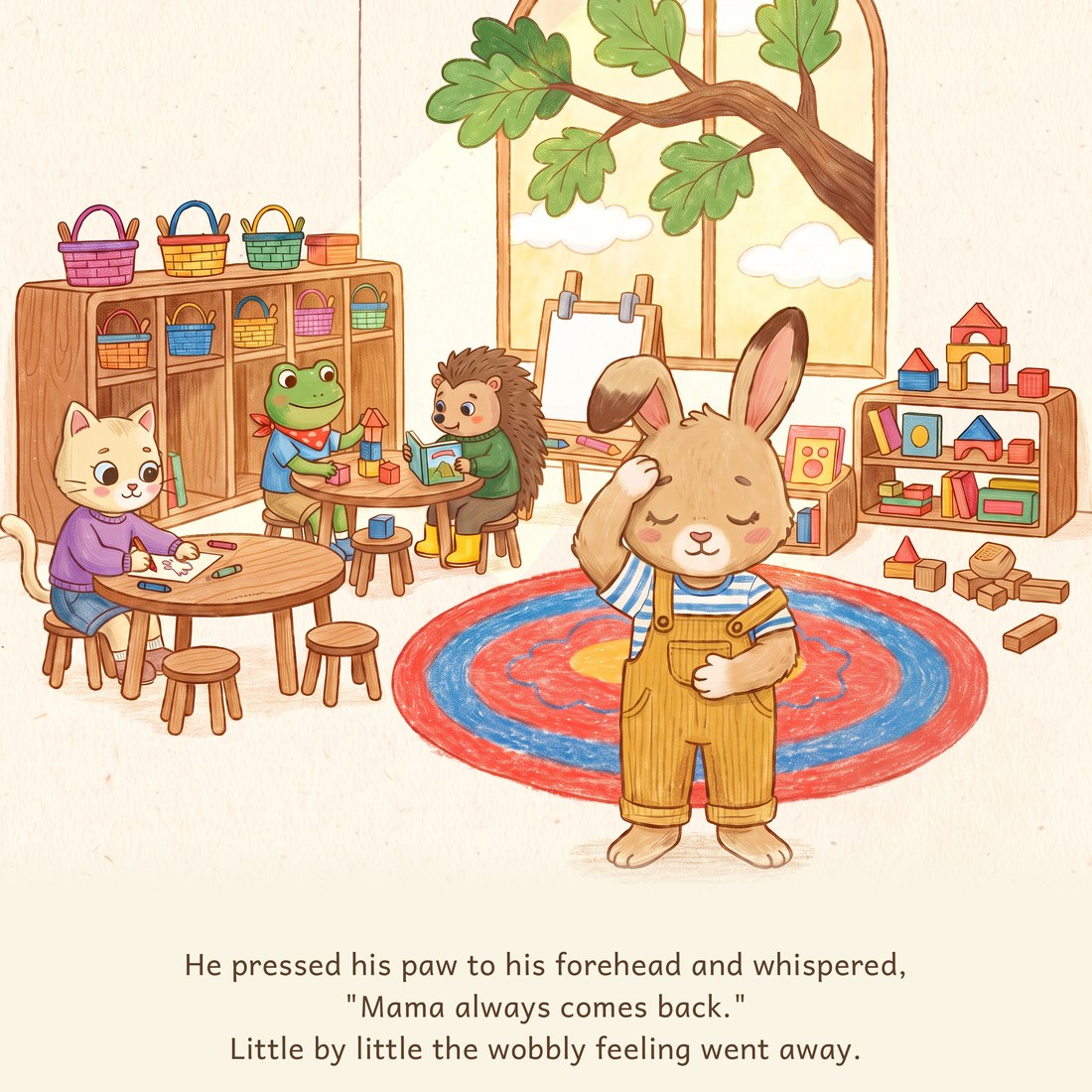
What it does. Pip's tummy fills with "popcorn" a week before school. Mama does not tell him to be brave. She tells him the wobbly feeling has two parts, a nervous part and an excited part, and they live in the very same place. Then they build a goodbye of their own: forehead boop, magic words, wiggly wave. They practice it all week, in the kitchen, at bath time, out in the front garden, and after each practice Mama slips out of the room for a little and comes right back. When Pip asks how he will know when Mama returns, Papa turns the day into a song: snack, play, bell, Mama at the gate. When he asks what happens if he cries, his big sister Hana says she cried a little on her first day too, then remembered her special goodbye and felt better.
Best for: a child who worries in the days before, and a parent who wants a plan for the door. The book is the rehearsal. By the time the real morning arrives, the goodbye is a rerun, not a surprise, and the return has a shape a small child can hold. Every copy also comes with a free grown-up kit: a goodbye ritual chart, first-week tips, and talk-about-it questions.
Where it stops. It is new, so your child's teacher will not know it yet. And it is built around the goodbye. If the door is easy and the sadness only shows up mid-morning, Llama Llama hits that moment more directly.
How to choose
- Worries start days before school. Start with Pip. The practice is the point.
- Cries at the door. Pip for the ritual, then The Kissing Hand for something to carry through the door.
- Fine at the door, sad by snack time. Llama Llama Misses Mama first. Add the kissing hand if a teacher can prompt it.
- Asks "when will you be back?" all morning. Pip. Papa's school song turns the wait into a sequence a three-year-old can count down.
They also pair well. Read Pip the week before to build the goodbye, and keep The Kissing Hand or Llama Llama for the first-week bedtimes, when your child wants to see that missing you is normal and that it ends. The three-step goodbye ritual works with any of them.
How we compared them
We read all three as parents, not as critics. We wrote one of them, so weigh our view accordingly. Facts about the other two books come from their publishers' listings, not from memory. The links to The Kissing Hand and Llama Llama Misses Mama below are plain links, not affiliate links. For the research behind Pip's approach, see separation anxiety at drop-off.